Friday, November 11, 2016

Next stop: New Plymouth

Kakaramea Hall with Mount Taranaki in the background.
The weather on our drive from Hawera to New Plymouth was wonderful, which meant we spent some of the drive 'mountain chasing', with (I think) good success.
A farmhouse with Mount Taranaki in the background.
I also had a mountain view from my bed at the Airbnb place we were staying in, but that was less good luck and more good shopping on my part!
Bed and bedside table. On the table is a small pottery mountain.
Our Airbnb bach was perfect. From the fresh baking waiting with the welcome note,
A tin of baked slice with a welcome note from an Airbnb host.
to the perfectly-placed chairs on the patio overlooking the sea (which reminded me that I really need to get back to work on my writers' retreat).
Two adirondack chairs on a holiday house porch.
We popped into the local village for fish and chips on our first night
A pair of muddy gumboots outside a fish and chip shop. Inside, the owner of the boots is ordering at the counter.
which we washed down, as per family tradition, with a bottle of New Zealand bubbles
Fish and chips and a bottle of sparkling wine.
before watching the sun set into the sea.
Sunset over the sea.
(We loved the bach's deranged-looking seagull).
View of the sea, with a slightly deranged-looking wooden seagull in the foreground.
Being from a land-locked city, I had to go for a walk along the beach
Large rocks on a New Zealand black-sand beach at low tide.
(which, with large rocks and black volcanic sand,
Large rocks on a New Zealand black-sand beach at low tide.
may not look much like the beaches you know).
Large rocks on a New Zealand black-sand beach at low tide.
One of the main reasons for our trip to New Plymouth was to visit The Len Lye Centre, a recently-opened gallery celebrating the work of renowned New Zealand kinetic artist Len Lye:
The exterior of a modern building made with undulating metal. Reflected in the metal is an old town clock tower.
The interior of a modern building made with undulating concrete.

 Here are a couple of short videos I took of a couple of his pieces that were on display: Flip and Two Twisters,


and Zebra:
and an image of Once More with Feeling, a work by Rebecca Baumann.
Shadows of two people against an artwork made up of many colourful stripes.
Our final pilgrimage while in New Plymouth was to Tupare, a beautiful arts-and-crafts house created by Taranaki architect James Chapman-Taylor, set in extensive gardens.
Entryway of an old arts-and-crafts-style building.
This involved the major disappointment of the trip: we knew in advance that we wouldn't be able to time our visit to coincide with one of the regular guided tours of the inside of the house, and were heartened to read that tours could be organised by prior arrangement.
Side of an old arts-and-crafts-style building.
Alas, we never got a reply to our inquiry.
Side of an old arts-and-crafts-style building.
Which I suppose we should be pleased about really,
Front of an old arts-and-crafts-style building.
as it gives us another good reason for a return visit to the area!
Courtyard of an old arts-and-crafts-style building.
We did manage to wander around some of the garden, though.
English-style garden with park bench and arch trellis.
Two people admiring an english-style garden in front of an arts-and-crafts-style cottage.
And visit the gardener's cottage,

A man walking up a path in an english-style garden to the entry of an arts-and-crafts-style cottage.
which, luckily, was open.
Inside view of an arts-and-crafts-style cottage, with a desk and chair under a window.
Inside view of an arts-and-crafts-style cottage, cane armchairs under a window.
An arts-and-crafts-style cottage set in an english-style garden.

Thursday, November 10, 2016

Tawhiti: behind the scenes

By this time word had spread that there was a miniaturist visiting the museum, and The Parental Units came to find me in order to tell me that the owner would like to meet me.
A man poses in front of a diorama of 19th-century soldiers marching in the New Zealand bush.
Nigel Ogle (a former art teacher) bought the old Tawhiti Dairy Factory in 1975, not realising at the time that he would end up turning it into a museum, let alone an award-winning museum.
A man poses in front of a diorama of an encampment of 19th-century soldiers by the sea.
Since 1988, the museum has been open regular hours, and he's been working on the exhibits full time.
Man standing thinking in front of a diorama of 19th-century soldiers in the bush.
When we visited, Nigel was working on a new room containing a diorama of a Taranaki battle, based on watercolour images created by an artist of the time (he told us the name, but alas I neglected to write it down and have since forgotten it...)
Diorama of 19th-century soldiers moving supplies from the beach up to an encampment.
The detail was perhaps even more amazing than the scenes I'd already been admiring,
Diorama of 19th-century soldiers fetching water from a stream.
and Nigel pointed out his use of forced perspective to draw your eye to the very back of the scene.
Diorama of 19th-century soldiers at an encampment.
Two men in front of a diorama of 19th-century soldiers marching through the bush.
He also explained how his approach to creating the bush has changed over the years.
Two men in a workshop area, in front of a diorama in progress.
Earlier scenes had plants made of paper, but now he uses a combination of materials such as etched copper leaves, cheap dusters from The Warehouse (alas, I forgot to hunt any down while I was in the country),
Man holding a piece of a duster as an example of how to make bush from unexpected objects.
and railway modelling material.
Two people looking at a piece of railroad modelling greenery, as a man explains how it's used.
While we were talking, his daughter arrived with a supply of toetoe grasses that she had just finished painting,
WOman at an open door, giving a man a box. The man is picking up one of the objects inside.
and Nigel demonstrated how they would be placed into the bush
Man holding a bunch of miniature toetoe grass, with a box of it in his other hand.
Man placing a piece of miniature toetoe grass into a diorama bush scene.
(another example of drawing the viewer's eye into the back of the scene).
Man straightening a piece of miniature toetoe grass in a diorama bush scene.
Clump of miniature toetoe grass in place next to a stream in a diorama.
He also pointed out the takahÄ“ down by the water: a little 'easter egg' for those with sharp eyes.
Two miniature takahē at the edge of a stream in a bush diorama.
As I said before, I really loved the realism he's achieved with his representation of the New Zealand bush.
Miniature New Zealand flax plants in a diorama.
Man pointing a stick at miniature flax plants in a diorama.
Man pointing a stick at miniature cabbage trees  in a diorama.
Fingers next to a cabbage tree in a diorama, showing scale..
And the coast. I was particularly impressed by the way be merged the painted backdrop with the modelled parts of the diorama.
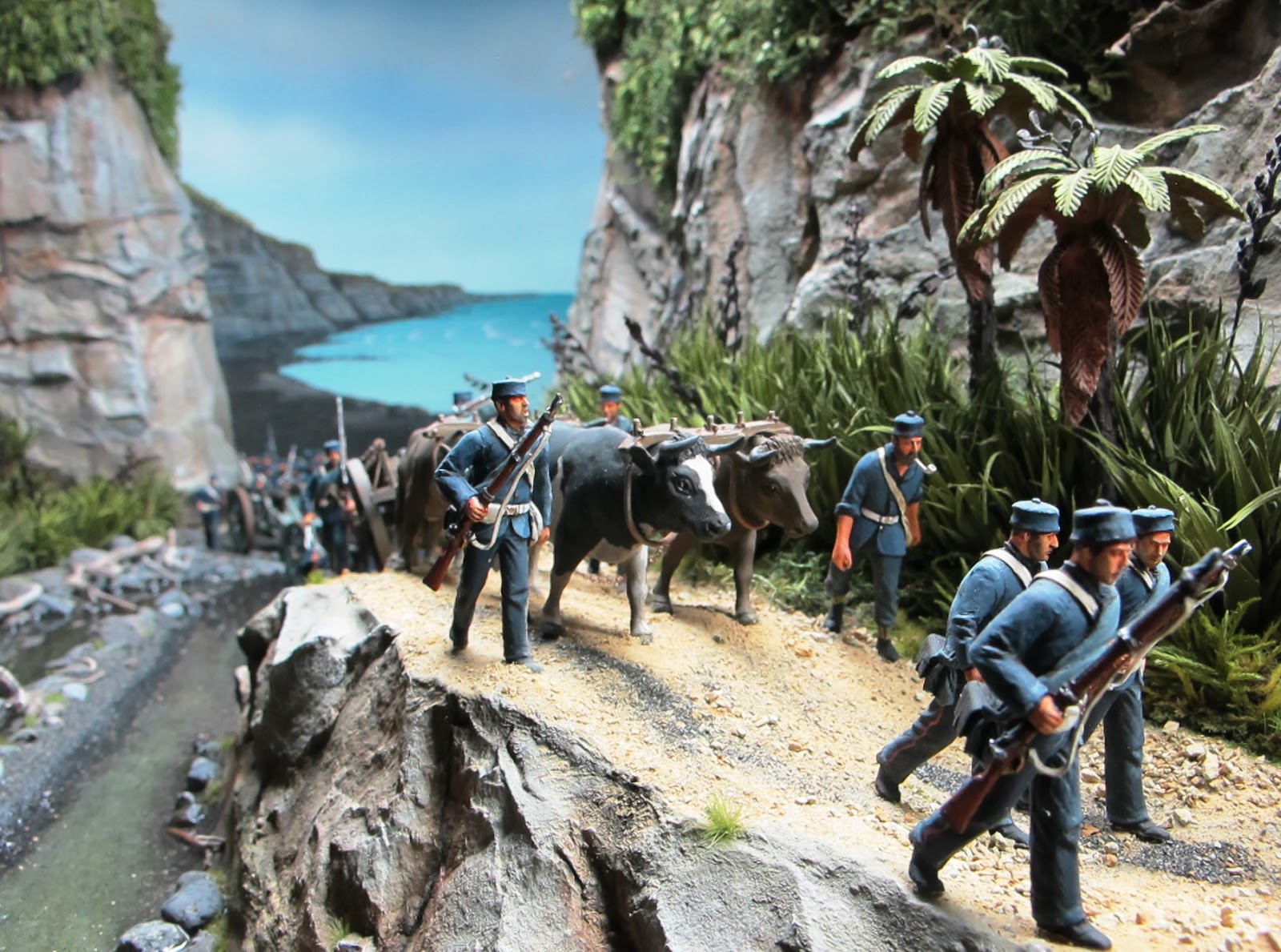
Diorama of 19th-century soldiers crossing a creek by the sea.
Diorama of 19th-century soldiers crossing a creek and mounting a track by the sea.
And presented a new story everywhere I looked...
Diorama of 19th-century soldiers walking along a track near the sea.
Diorama of 19th-century soldiers fixing a landslide on a track.
(while drawing the eye ever onward through the diorama).
Diorama of 19th-century soldiers fixing a landslide on a track. In the foreground is a large cabbage tree.
Woman standing next to a diorama of 19th-century soldiers in an encampment in the bush.
If you're ever in New Zealand, I highly recommend making the time to visit Tawhiti Museum in Hawera.
Diorama of bush by the sea.
I know I have to go back for another visit as I missed a whole section, which I believe contains some more awesome 1/12-scale miniature scenes. And to think I almost missed it...
Diorama of bush by the sea.
Finally, if you need to be convinced (or perhaps live too far away for an in-person visit to be realistic), you might enjoy this video:

Wednesday, November 09, 2016

Tawhiti: Life at war

Room with full-scale models of Maori in traditional dress on the left, and a long diorama on the right.
The next rooms I visited at Tawhiti Museum were about the military history of the area, particularly The Musket Wars, and the story of Kimble Bent in the Taranaki wars of the 1860s.Normally this would be something I'd gloss over, but because of the intricacy of the scenes I found myself stopping constantly to read the information attached and peer closely at the details of the scenes.
Diorama of Maori with muskets in a trench, defending a pa.
The focus was very much on the stories of the people involved, and by the end of my time in this part of the museum I was keen to find out more about the history of New Zealand, as I realised it wasn't taught much when I was at school: instead we tended to focus on European history...
Diorama of 19th-century Maori with muskets in the bush.
Diorama of a 19th-century man shoing a horse in the bush. Behind him is a camp of tents.
Diorama of 19th-century soldiers with muskets in the bush, aiming at a Maori by a pa fence.
Diorama of 19th-century soldiers with muskets in the bush, aiming at a pa fence.
Diorama of a 19th-century soldier standing in a stream in the bush, next to a horse drinking from it.
Diorama of a 19th-century man standing in the bush with his hands up,in front of a Maori on a horse.
Diorama of a 19th-century man on the back of a horse in the bush,being lead up a track by a Maori.
Diorama of 19th-century Maori with muskets on a track in the bush.
Diorama of 19th-century Maori with muskets on a track in the bush, watching a crowd of people around a flagpole in the distance.
Diorama of a group of 19th-century Maori  around a flagpole in the bush
Diorama of two 19th-century Maori being guided along a track in the bush by a third.
Diorama of a 19th-century Maori family being guided along a track in the bush by a pakeha man.
Diorama of a 19th-century Maori family being sneaking along a track in the bush. Behind them in the bush is a mass of pakeha soldiers.
A full-sized diorama of a pakeha man and a Maori man in a Maori hut. The pakeha is working on agun.