Monday, November 14, 2016

Forties fashion

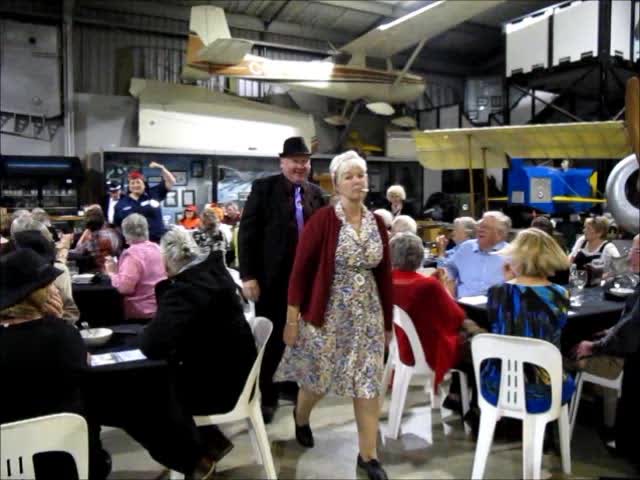
The delegates at this year's NZAME convention really got into the 1940s theme, many of them wearing a different 1940s-themed outfit each day.
Two women dressed in 1940s outfits, crafting on a table at a workshop.
Two women dressed in 1940s outfits, standing in front of displays at a miniatures convention.
Jackie Smith wore her going away hat from her wedding in the early 1950s:
A woman dressed in a 1940s outfit, standing in front of her stall at a miniatures convention.
Three women dressed in 1940s outfits at a stall at a miniatures convention.
Three women dressed in 1940s outfits behind a stall at a miniatures convention.
While others told stories of year-long op shop (thrift shop) quests
Two women dressed in 1940s outfits, sitting on plastic chairs and drinking coffee and eating muffins.
to find appropriate outfits for themselves and their friends.
Two women dressed in 1940s outfits posing in front of a model of a villa at a miniatures convention.
Others took to their sewing machines.
Three women dressed in 1940s outfits in front of a stall at a miniatures convention.
Of course, there had to be at least one Rosie the Riveter,
Two women dressed as Rosie the Riveter.
and someone in a gymslip!
A woman dressed in a 1940s gym slip poses behind a table at a dinner.
Two women dressed in 1940s outfits pose with a woman in a gym slip.
A woman dressed as char lady poses with her broom in front of an empty table.
I took a wee video of the costume parade of the night, so you can see the range of outfits:
NZAME 2016 Convention dinner parade

Sunday, November 13, 2016

Another day, another road trip...

I'd been back in Wellington for just over 36 hours when I was off again. My first road trip had taken me up the left-hand side of the North Island, and this time I was heading up to the right-hand side.
People packing a minivan for a road trip.
With a van-load of fellow miniaturists
View of Lake Taupo, with cabbage trees in the foreground.

The theme was 'The 1940s', and I was impressed by the organisers' attention to detail. The usual convention goodie bag was, instead, a Red Cross parcel*, and our meal tickets came in ration books.
Cardboard box made to resemble a Red Cross box, next to a ration book and a name tag for NZAME convention 2016.
The venue, an aviation history museum, was also perfectly chosen for the theme (and made for great photos throughout the weekend!)
Group of people talking at a table in a hanger, with vintage airplanes suspended above.
After the first evening's events (there was shopping, which I'll tell you about later) we returned to our accommodation for the weekend, changed into our PJs and opened our goodie boxes over a couple of glasses of wine.
Two open cardboard boxes in the style of Red Cross boxes. Between them is a glass of sparkling wine, and a hand reaches into the back one.
Most of the contents fitted with the convention theme, and included knitting patterns and  khaki knitting wool, magazines and books from the time, a school satchel, a game of scrabble and a pair of stockings.
Empty cardboard box in the style of a Red Cross box, with a selection of 1940s-themed miniatures spread out in front of it.
Of particular note for me was a manual toaster (courtesy of Garden City Miniatures),
1/12-scale vintage toaster with drop-down sides, and a box for it.
a portable gramophone (by Ginny, Mike and Louise Ind of East Coast minis group),
1/12-scale vintage portable record player.
a Brownie camera and photo wallet (W.W.W. club)
1/12-scale vintage box brownie camera and photo packet, on a full-sized advertisement for the camera.
and a gas mask in its box (North Shore Miniatures Club).
1/12-scale vintage gas mask and box containing instructions for use.
(*Also very handy for getting miniatures home safely!)

Ho what fun*

Inglewood is a town about 20 minutes out of New Plymouth, and contains the Fun Ho! Toy Museum. I was keen to visit as I'd been reading about the company in the book Hello girls and boys!: A New Zealand toy story, which I picked up on a previous trip to New Zealand. I was particularly interested in visiting to see if I could find more out about their links with Jomax, who made one of the dolls' houses on my wish list.

When I was planning our road trip I mentioned to The Parental Units that I'd like to pop in to the museum for a quick visit while we were in the area, to which I got an unexpectedly enthusiastic response. Because, of course, these were the toys of their childhoods. So with a big tick from everyone involved, a visit was locked in to the itinerary.
Woman posing in a cardboard car in front of a sign saying 'I was here...Fun Ho! Toy Museum'
Sign explaining the story of Fun Ho! toys
The museum is situated on the main street, and contains a large room displaying shelves and shelves of items made by the company over the years,
Rows of metal cars displayed on shelves in glass cabinets lining the walls.
plus a slot car setup
Rows of metal cars displayed on shelves in glass cabinets lining the walls. In the front left is a slot-car set up under perspex.
and an old Bedford van in the middle, containing a model railroad set up.
Old Bedford van in the middle of a museum room.
Model railway layout inside an old Bedford van.
(Now there's an unusual container for minis!)
Detail of a model railway layout inside an old Bedford van.
On top of the display cases are a range of the moulds used to make the original toys
Moulds for sandcasting toy cars on display.
and in the 'Fun Ho! Foundry' room next door, displays of lead toys and the moulds to make them
Miniature lead toys displayed in their moulds.
(because making toys out of lead is an excellent idea!).
Painted miniature lead toys on display.
In the same room is information on the process used to sandcast the toys
Display showing how metal toys are sandcast.
and finish them off.
Display showing how metal toys are finished.
Mould used for sandcasting miniature road signs.
Plus various other displays of the process
Display showing how a new toy car design in created.
and tools involved.
Pieces of metal arranged on numbered shelves.
But I was here for the dolls' house furniture, which made up just one display case in the main room:
Glass display case containing shelves with various sets and pieces of metal dolls' house furniture displayed on them.
On the top shelf were three metal model bungalows, and I hoped that they would be one of the items that were being re-cast for sale in the museum shop (alas, they weren't).
Small moulded metal bungalow.
This is where my disappointment set in: as I found the labelling not very useful at all. The label behind this house read 'Kit set No 1 gabled house 1948',
Small moulded metal bungalow.
but the next two houses on the shelf had no information at all.
Small moulded metal bungalow with instruction book behind.
Similarly, the boxed sets on display had labels like you see below
Set of metal dolls' house bathroom furniture displayed in its box.
that didn't tell me much either.
Set of metal dolls' house bathroom and kitchen furniture displayed in its box.
Which got me wondering why. Was it perhaps a) the curator assumed that visitors were experienced collectors, so knew what they were looking at b) the museum was aimed at people (like my parents) who were visiting to look for items they had as children, rather than to learn about the items, or maybe c) the museum didn't have the knowledge or funding to provide this information? 
Set of metal dolls' house bathroom furniture displayed in its box.
I visited the front desk to see if there was a general book about the company which might give me more information, and found only a couple of collectors' guides (making me suspect that option a was correct). 
Set of metal dolls' house bathroom and kitchen furniture displayed in its box.
I then asked the person behind the desk if she could tell me anything about the link between Jomax and Fun Ho! Toys. And got a blank look. It slowly dawned on me that, although there were a range of reconstructed Fun Ho! toys and other souvenirs for sale, perhaps this was the information centre for the town, and not for the museum: and the museum just happened to be located in the same building (option c seemed a likely reason).

I returned to taking photos of the items on display (Rebecca: I've labelled the photos in FLICKR with the information that was provided),
Set of metal dolls' house table and chairs displayed in its box.
wondering if anyone had done any in-depth research into the Fun Ho! dolls' house pieces at all, as they were fairly obviously an after-thought for the company...
Metal dolls' house kitchen range.
Metal dolls' house chair, bath and toilet.
Metal dolls' house bathroom furniture.
I was also very aware that my recent experiences at Tawhiti Museum may have raised my expectations of what a provincial museum would be.
Fun Ho! logo of a clown carrying a sign with 'Fun Ho! toys' written on it.
Did I enjoy my visit? Yes, although I didn't learn the things I was hoping to. Was it worth the cost of entry? Also yes, if I measure it in 'interesting things to look at' and 'time spent there'.

If you're interested, there are a few reconstructed dolls' house items for sale on their website, and someone has posted a walk-through video to You Tube...

(Actually, not really as I spent five hours creating this post and then it disappeared. So this is the second version in as many days...)